
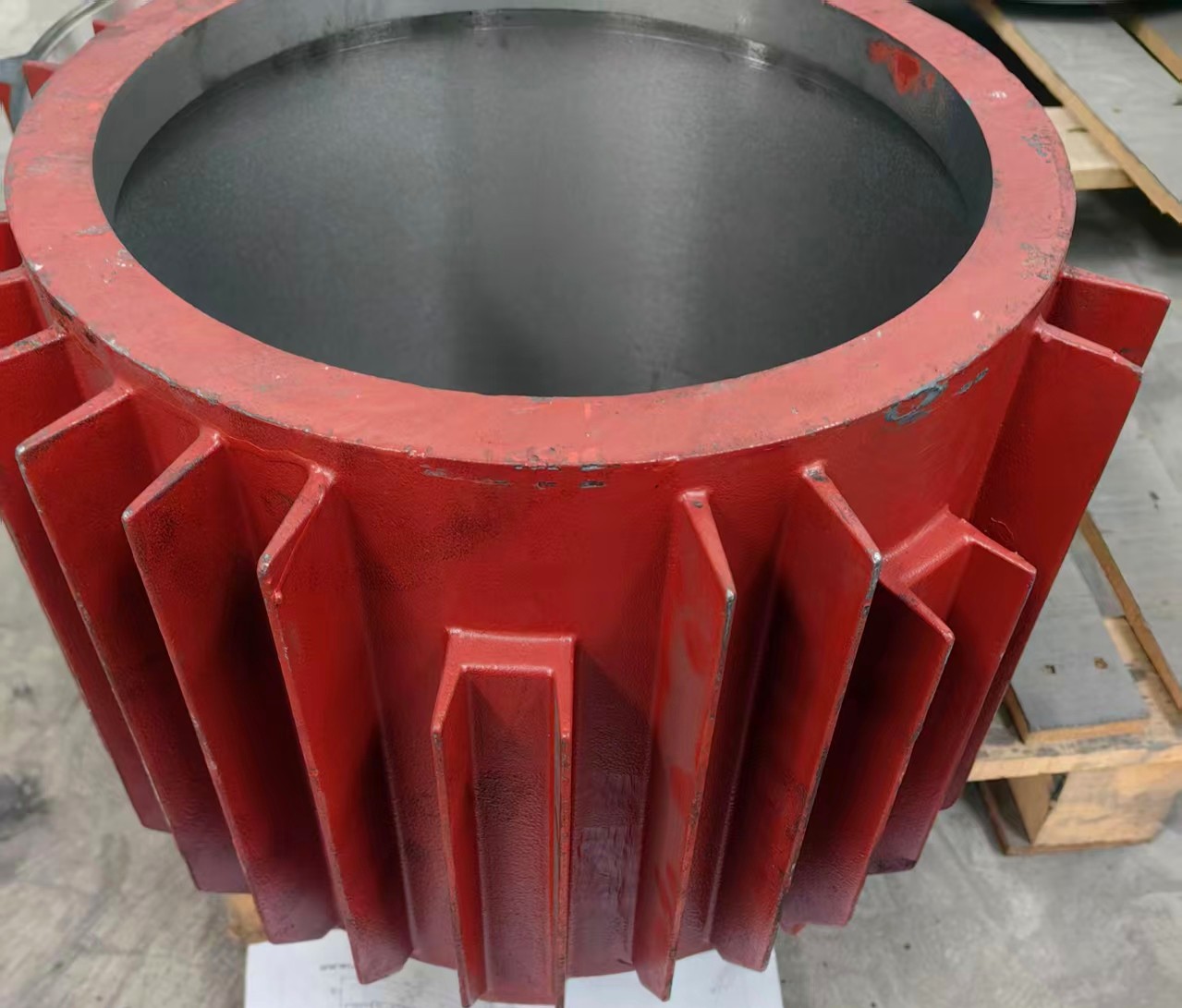
Drawings for cranes and hoists across Europe still carry cast iron codes written decades ago: GG25, GGG40, sometimes GGG40.3. The standards behind those codes were withdrawn years ago, and every foundry now works to EN, GB or ASTM designations instead. Most of the time the conversion is routine. When it is not, the casting is made from a material nobody intended — and the mistake is usually found after machining, when it costs the most.
This is the conversion we use, and the reasoning behind choosing each material for a specific part.
Two families, not a single scale
Every grade below falls into one of two families, and the difference is the shape of the graphite inside the iron:
- Grey iron (EN 1561, EN-GJL) — graphite in flakes. Outstanding vibration damping, excellent machinability, high compressive strength, but low tensile strength and almost no elongation. It is stiff and it cracks rather than bends.
- Ductile iron (EN 1563, EN-GJS) — graphite in nodules. Several times the elongation of grey iron, real impact strength, and it can be heat treated to much higher strength.
Choosing between them is not "which is better". It is: does this part need to absorb energy, or does it need to hold its shape and swallow vibration?
Grade conversion: DIN to EN, GB and ASTM
| Old DIN | Current EN | Typical GB | Approx. ASTM | Where it is used on cranes |
|---|---|---|---|---|
| GG20 | EN-GJL-200 | HT200 | ~A48 Class 30 | Light covers, guards, non-loaded housings |
| GG25 | EN-GJL-250 | HT250 | ~A48 Class 35 | The default for motor housings, end shields, bearing caps |
| GG30 | EN-GJL-300 | HT300 | ~A48 Class 40 | Higher-duty housings, wear faces, cylinder liners |
| GGG40 | EN-GJS-400-15 | QT400-15 | A536 60-40-18 | Brackets and cases that see shock |
| GGG40.3 | EN-GJS-400-18-LT | QT400-18L | A536 60-40-18 (LT) | Outdoor cranes in cold climates — Charpy verified at low temperature |
| GGG50 | EN-GJS-500-7 | QT500-7 | A536 70-50-05 | Wheel gears, loaded structural castings |
| GGG60 | EN-GJS-600-3 | QT600-3 | A536 80-55-06 | Wear parts needing high strength and hardness |
Two things worth knowing about the columns. Old DIN numbers state the tensile strength in MPa only. Current EN designations state both — EN-GJS-500-7 means 500 MPa tensile with 7% elongation — which is why quoting the full EN code always beats quoting "GGG50". And the ASTM column is an approximation: A48 classes are expressed in ksi and do not line up exactly with EN strengths, so treat that column as orientation, not a specification.
Which grade belongs on which part
| Part | Material we usually make it in | Reason |
|---|---|---|
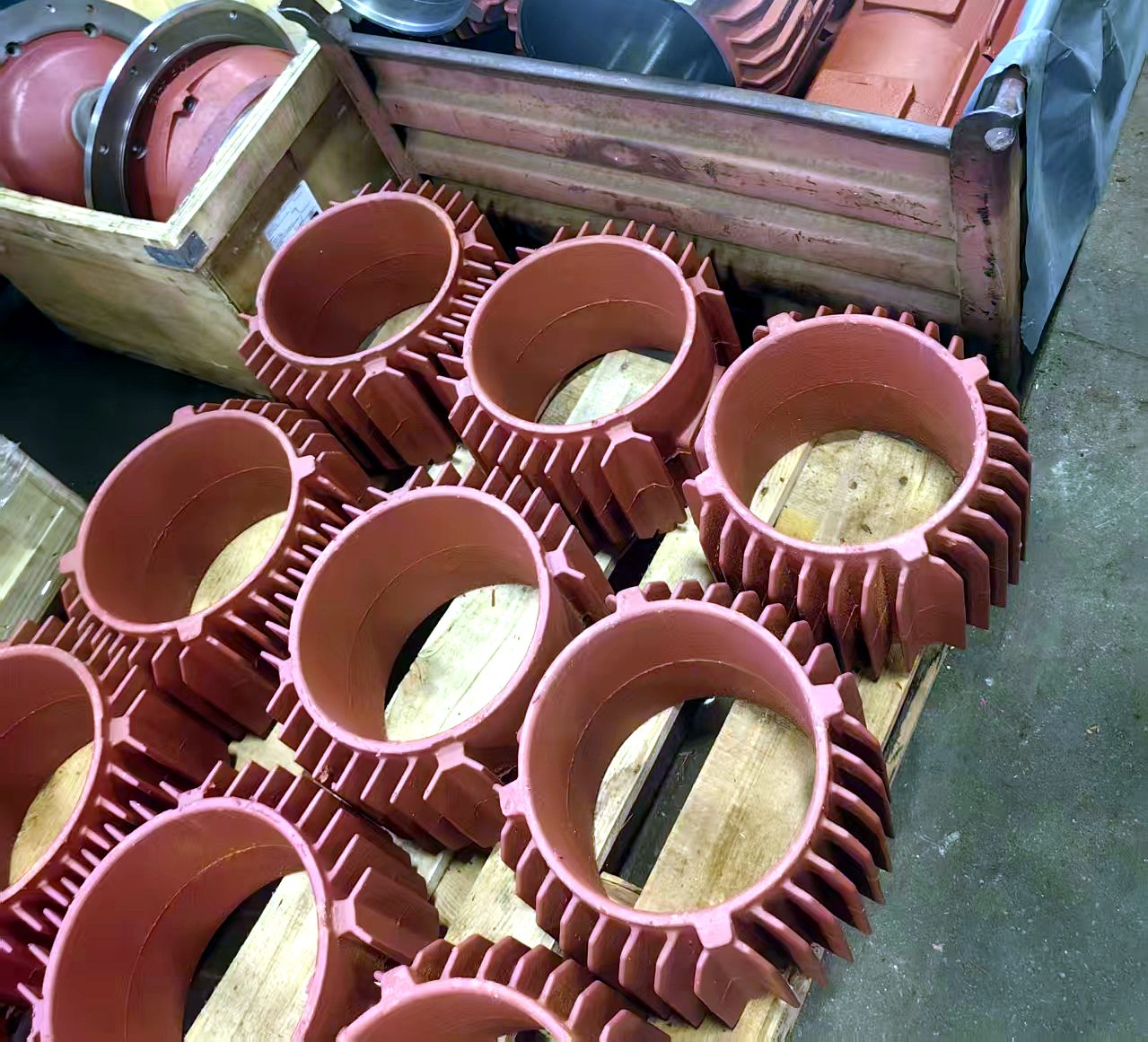
| Motor housing / frame | EN-GJL-200 or EN-GJL-250 | Stiffness and damping; no shock loads on the part itself |
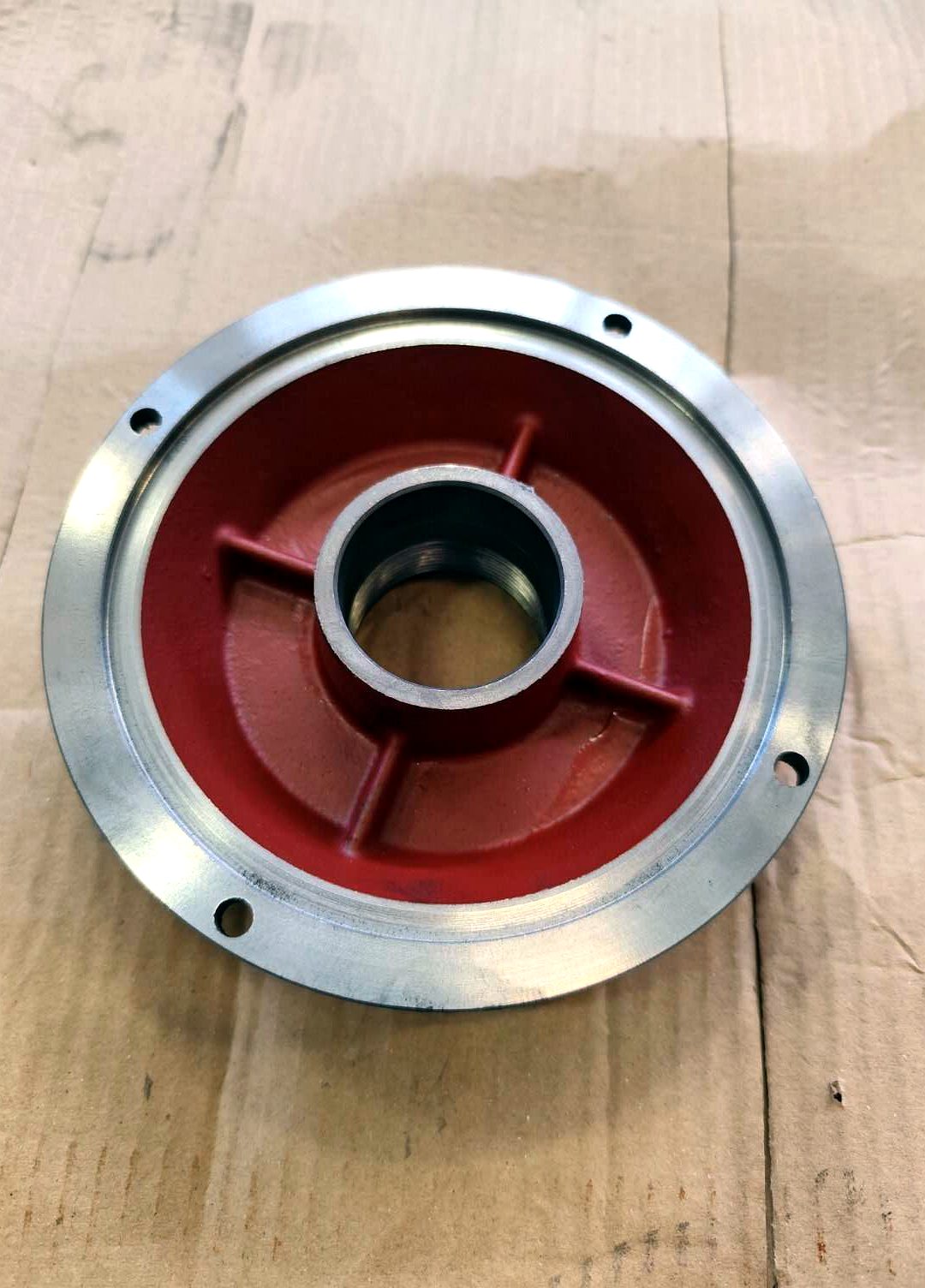
| End shield | EN-GJL-200 or EN-GJL-250 | Needs even wall hardness for bearing fit — typically 180–230 HB |
| Bearing cap | EN-GJL-250; EN-GJS-500-7 when loads rise | Clamping accuracy under bolt load |
| Brake drum | EN-GJL-250 for heat dissipation and wear; EN-GJS-500-7 where shock torque is high | Thermal conductivity plus wear behaviour; ductile iron absorbs brake engagement shock |
| Travel wheel gears, wheel hubs | EN-GJS-500-7 or EN-GJS-600-3 | Rolling contact plus shock — grey iron is too brittle here |
| Heavily loaded brackets, couplers | EN-GJS-500-7 and above, or cast steel | Section loads beyond ductile iron capability move you to cast steel |
Three specification lines that decide whether the casting performs
1. Section thickness changes the strength you actually get
Grade properties are verified on a standard test bar, usually around 30 mm. A 60 mm wall on your casting cools far more slowly and comes out weaker and softer than the bar. If your part has heavy sections, either accept lower properties or state hardness measured on the casting itself — this single line prevents most surprises.
2. Where hardness is measured
Specify both the range (180–230 HB is typical for motor parts) and the location: on the machined face, on a cast-on coupon, or on a separately cast test bar. Most incoming-inspection disputes come from one party measuring the casting and the other quoting the test bar.
3. Stress relieving before finish machining
Large housings and end shields carry casting stress. If it is not relieved before the final cut, the part moves after machining and your bearing bore is no longer where it was when you measured it. Say whether you require the casting as-cast, stress relieved or annealed.
What to send with your inquiry
- Full grade designation — EN-GJS-500-7 rather than "GGG50" — plus any acceptable alternative
- Hardness range and where it is measured
- Whether properties are verified on the casting or on a separately cast test bar
- Heat treatment condition required: as cast, stress relieved or annealed
- Critical surfaces and any NDT — visual, magnetic particle or ultrasonic on load-bearing areas
- Documents required: EN 10204 3.1 certificates with heat-number traceability, plus full dimensional FAI report on the first article
From our production base in Wuxi we supply cast motor housings, end shields, bearing caps and brake drums — cast, heat treated and machined complete to your drawing. Hardness is recorded per batch, typically 180–230 HB for motor parts, and every shipment carries EN 10204 3.1 certificates tied to heat numbers.
Send us the drawing, or a photo of the old part with the rough dimensions. We confirm which grade we intend to pour before the pattern is made — not after.
Need these parts made to your drawing? Send your specification — clear quotation within 24 hours, EN 10204 3.1 certificates as standard.
Get a Quotation